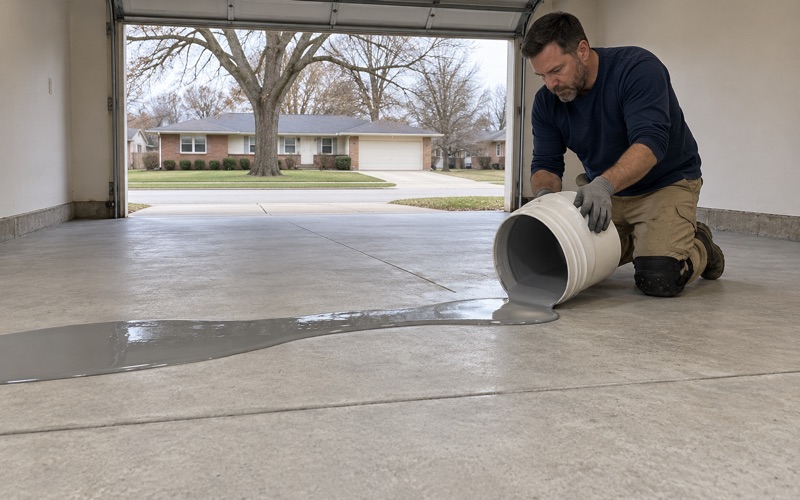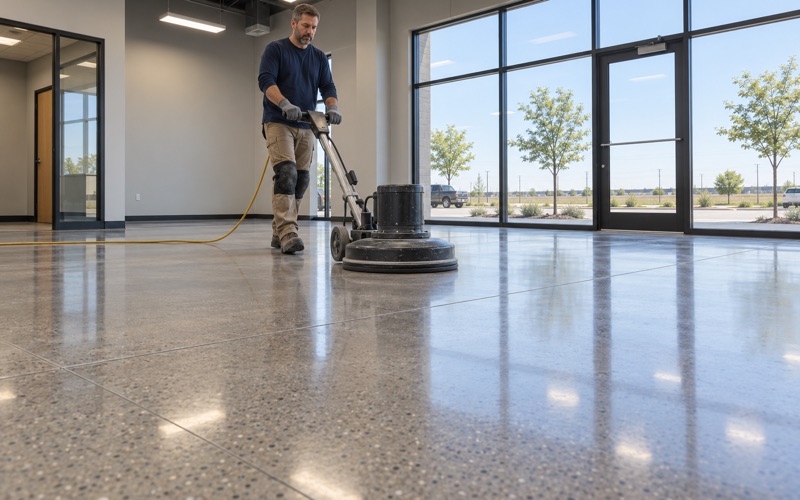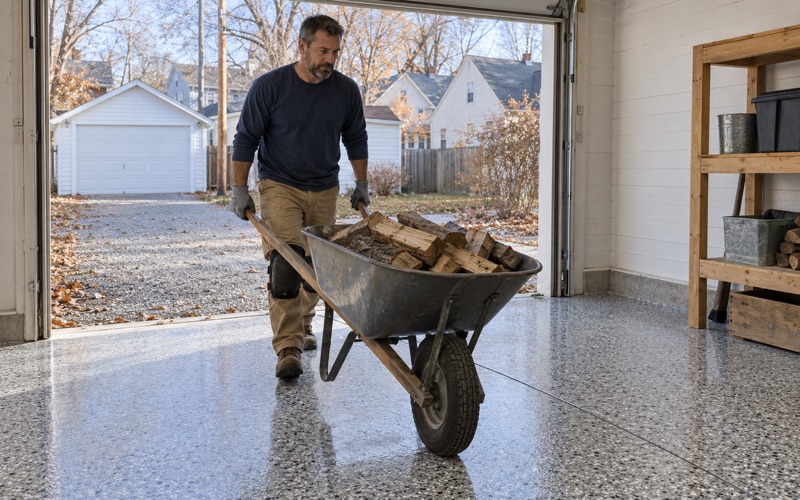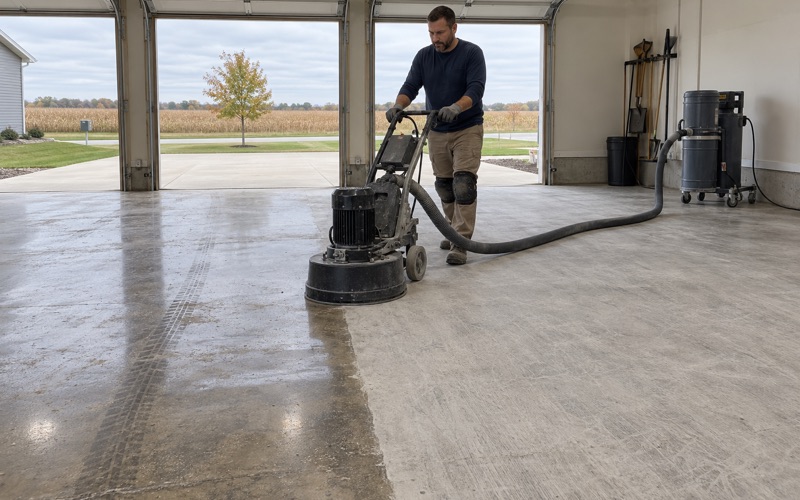
Cedar Falls Epoxy Flooring has put more than 20 years into concrete coatings, and our epoxy flooring in Waverly covers attached garages, basements, shops and the working floors of plants and warehouses. Every job starts on the slab itself: we walk it and map the cracks, spalls and old coatings before a number is written, and when the concrete needs repair or replacement before it should be coated, we tell you so in plain terms.
The proposal you receive names the product line, how many coats go down and the finished thickness, so the completed floor can be checked against the paper. A moisture test is part of that scope before the price is final, whatever year the building went up, because a newer slab is not automatically a drier one. We open the surface with a diamond grinder or a shot blaster rather than an acid etch, and the proposal states the ICRI concrete surface profile we are grinding to.
Commercial floors bring a second question that a garage rarely does: not only what the coating can take, but what the room around it can tolerate while the work is happening. Nowhere is that question sharper than in a room where dry food powder is handled, and that is where most of this page goes.
A Century of Dairy and Cocoa Powder in Waverly
Waverly, the Bremer County seat on the Cedar River, has a long history with dry dairy products. Local history traces the city’s Nestle plant to a Carnation plant that began in 1923; Nestle bought Carnation in the 1980s, Nesquik was being produced there by 1995, and Ovaltine came later. A June 2023 Waverly newspaper marked the facility’s 100-year milestone and recalled the town’s old nickname from around the 1930s, the Dairy Spot of Iowa.
A 2017 report in Powder & Bulk Solids described the plant as making hot cocoa mix, Nesquik and other products. A 2023 account of a Senate tour of the plant reported Waverly as the only producer of powdered Chocolate Nesquik in the U.S. and Canada. Whatever the exact product list in a given year, the work is the same kind of work: mixing and packing fine, dry powders that are meant to stay dry.
What we know, and what we do not
We have no relationship with Nestle, we have not coated any floor in that plant, and we have not read its floor specifications, sanitation program or construction policy. How that facility cleans or what it requires of a contractor is its own business, and we will not guess at it on this page.
What we can describe is the published industry guidance written for rooms like these, and what it means for anyone in Waverly planning floor work in a dry-mix, blending, packaging or ingredient room. That applies to a large plant and equally to a smaller operation handling powdered product.
Looking for epoxy-flooring closer to Independence? See Epoxy-Flooring in Independence.
Why Water Is the Hazard in a Dry-Mix Room
In 2009 the Grocery Manufacturers Association published Control of Salmonella in Low-Moisture Foods, prepared by an industry task force that included Nestle USA. Its scope covers products such as dried dairy products and confections including chocolate. It is industry guidance rather than a regulation, it names no floor product, and no coating makes a room Salmonella-free. Its central point is still worth building a floor around: in a dry processing environment, the document calls water perhaps the single most important factor in Salmonella contamination.
Dry cleaning as the everyday routine
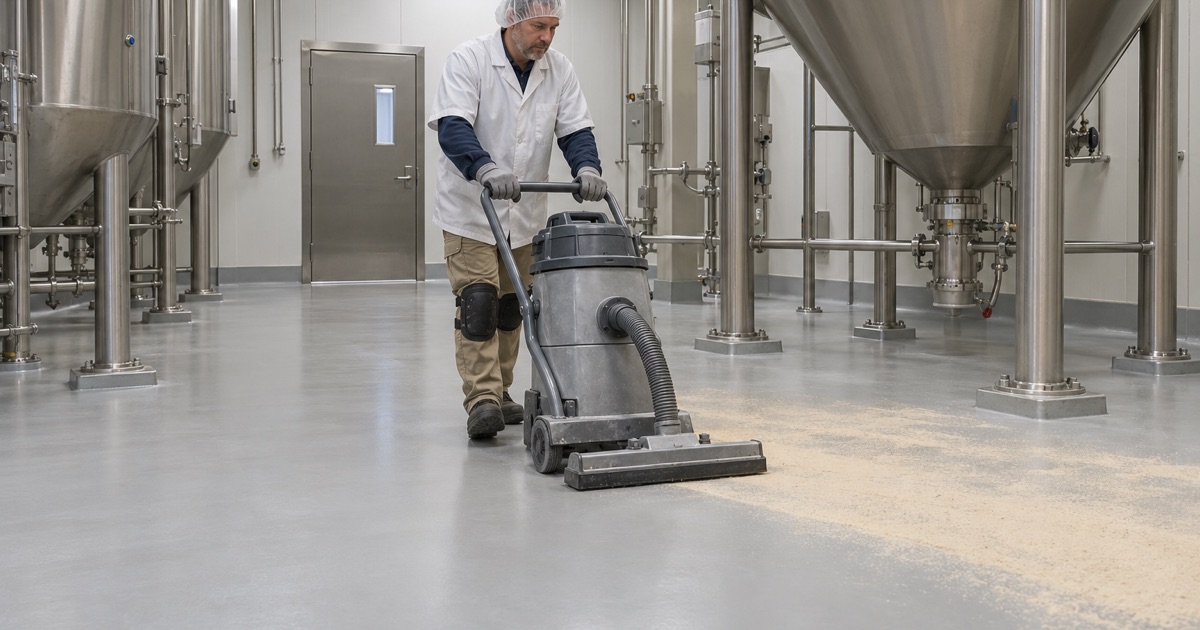
The guidance tells plants to minimize water across the entire plant environment and to choose dry cleaning as the routine cleaning practice in the Primary Salmonella Control Area, the zone where exposed product is handled. Controlled wet cleaning is reserved for infrequent use. The document notes that dry cleaning has been applied successfully for many years in producing low-moisture foods such as dried milk, using brushes, scrapers, dedicated vacuum cleaners and dry carbon dioxide blasting where other food rooms would use a hose. It goes as far as recommending capped dry drains in these areas, which says a great deal about how little water the room is meant to see.
Those tools ask something specific of a floor. A brush only clears what it can reach, a vacuum head lifts powder off a smooth plane but not out of a pit, and a scraper catches on a lifted edge and tears it further. A floor that looks sound under a hose can still fail a dry room, because every small void it carries becomes a place the daily cleaning cannot get into.
Cracks, joints and pits as hiding places
The same section lists harborage sites: junctions, cracks, holes and dead-end areas. It warns that serious Salmonella problems may develop when wet cleaning introduces moisture under equipment supports, into floor cracks and into other hidden spots where complete drying is not achieved. A crack in a dry room is a pocket that collects powder, and once water reaches it, a pocket that stays damp long after the surface around it has dried.
That turns the usual food-plant flooring question around. In a washdown room a floor is judged on surviving hot water and chemicals day after day. In a dry-mix room it is judged on whether there is anywhere at all for powder and moisture to settle: no open cracks, no unfilled joints, no pits and no coating edges lifting away from the slab.
A Floor Built for Brushes and Vacuums, Not Hoses
For a dry room we treat the defect map as the heart of the job rather than a step before it. Every crack, spall, saw-cut joint, anchor hole and old patch goes onto a plan before we price the work, and the plan travels with the proposal so the plant can see what will be filled, what will be rebuilt and what we think needs more than a coating.
Closing the defects before the coating
Cracks are routed out and filled, spalls are rebuilt and abandoned anchor holes are closed, because a coating laid over an open defect only hides it until the slab moves again. Where a joint has to keep working, we talk with the plant about how it will be filled and maintained rather than coating straight over it and letting it reopen as a fine line that holds powder.
The guidance singles out the ground under equipment supports, and so do we. Feet of mixers, conveyors and racking are where coatings are most often cut short or left ragged, so we plan with the plant which equipment can be moved, which has to be worked around, and how the coating will be finished tight to each base so no lip is left for powder to pack against.
A surface that sweeps clean
The body coat is typically a 100% solids epoxy, with a polyaspartic or urethane topcoat where the room sees scraping or carts, and urethane cement where occasional controlled wet cleaning or heat is part of the picture. Texture is weighed against the cleaning method: a room that is swept and vacuumed rather than hosed is usually better served by a finer finish, since a heavy broadcast holds powder in its peaks. The quote names the system, the coat count and the finished thickness either way.
Moisture coming up from below
A dry room can still have a wet slab. Vapor moving up through the concrete can blister a coating, and a blister that breaks open becomes a new pocket. We test with ASTM F2170 relative humidity probes or ASTM F1869 calcium chloride kits, and before the job is sold we explain that moisture vapor transmission and hydrostatic pressure are the first things a coating warranty excludes.
Floor Work on the Plant’s Terms
The GMA guidance treats construction and major maintenance as a contamination risk in its own right, because the work can dislodge microbial growth niches. It points to preventive measures such as temporary isolation of the work site, rerouting employee and equipment traffic, proper handling of waste material leaving the area and maintaining negative pressure in the work zone. In a dry food plant those decisions belong to the plant’s food safety team, and our job is to plan around them rather than around our own convenience.
In practice that starts with a walkthrough before any equipment comes on site. We want to know where the plant wants the work zone sealed off, which doors and corridors our crew and machines may use, where waste is to leave, and what the food safety team needs to see before a finished section is released. Those answers shape the phasing, the crew size and the price, so they belong in the proposal rather than in a conversation on the first morning.
Dust stays at the grinder
Our grinders and shot blasters run with vacuum capture at the machine, so grinding dust is collected where it is made instead of drifting toward product areas. We never rinse grinding slurry toward a floor drain, and in a room where water is the hazard, rinsing is off the table anyway. Waste leaves bagged and by whatever route the plant designates.
Phased around production
Plant and warehouse floors are phased around shifts, with overnight and weekend windows where production cannot stop. Cure schedules follow slab temperature and the dew point at the surface rather than the calendar, so a section is not handed back to forklifts or foot traffic until the coating is actually ready for it.
Codes and inspectors in Waverly
Waverly’s Chapter 90 Building Code adopts the 2024 International Building Code and the 2024 International Residential Code, and its permit exemptions include painting, tiling, carpeting and similar finish work. A coating inside an existing building generally falls in that finish-work category, but structural slab repair is a separate question, and the city is the one to confirm it. Restaurant and grocery floors in Bremer County answer to the Black Hawk County Health Department, which handles food establishment inspections here. On commercial work we carry the certificate of insurance a permit office or owner asks for, and we claim no credential that Iowa or Waverly does not issue.
- 20+ Years of Floor Work
- Moisture Test in Every Scope
- Free Written Estimates