Cedar Falls Epoxy Flooring has spent more than 20 years on epoxy flooring in Waterloo, and the floors that teach us the most are the ones kept below freezing. A cold room, a freezer aisle or a refrigerated dock asks more of a coating crew than reading a product label. It asks us to understand what is under the concrete before we decide what goes on top of it.
That is why our Waterloo proposals start with questions rather than a square-foot price. We map every crack, spall and old coating on the slab, write a moisture test into the scope, and name the product line, the coat count and the finished thickness so the result can be checked against the paper. When a slab needs repair, or a problem below it needs a different trade, we say so before anything is sold.
The same approach covers a two-car garage on the west side and a production floor that cannot stop for a week. The difference is how much is riding on getting the diagnosis right, and in a freezer that stake is high.
From Cedar River Ice to Waterloo Freezer Warehouses
Keeping food cold has deep roots here. The University of Northern Iowa’s history of Black Hawk County dates the ice cutting industry in the Waterloo and Cedar Falls area to the 1850s, when blocks were sawn from the frozen Cedar River and packed into ice houses for the warm months.
A local business that followed the cold
Crystal Cold, formerly Crystal Distribution Services of Waterloo, describes itself as a refrigerated warehousing company with locations in Waterloo, Mason City and Marshalltown. A directory profile of the company traces its start to harvesting and cutting ice off the Cedar River for preserving perishable food, and says the ice houses were later turned to cold storage. Its headquarters is listed on Sycamore Street.
Growth measured in square feet
The company’s own site reports a 21 million dollar expansion, completed in January 2023, that added 100,000 square feet of food-grade refrigerated space. It also describes a new 40,000-square-foot freezer planned for completion in 2026. We have no connection to Crystal Cold and have never worked in its buildings. We mention it because it shows something specific about this city: Waterloo has a working cold-storage floor market, and those floors fail in ways a garage floor never will.
Why that matters to anyone with a cold room
Freezer and cooler floors in Waterloo are not limited to large warehouses. Grocery back rooms, food distributors, butcher shops and restaurant walk-ins all run slabs that sit at or below freezing. Each one shares the same basic physics, and each one deserves a contractor who looks beneath the surface before quoting a coating. Smaller rooms vary widely in what was built beneath them, which is one more reason we ask rather than assume.
Looking for epoxy-flooring closer to Evansdale? See Epoxy-Flooring Services in Evansdale.
What Sits Under a Freezer Floor, and What Happens When the Ground Freezes
A freezer floor is not a slab on dirt. It is an assembly, and the coating is only the top layer of it. Below the wear slab sits a thick layer of insulation, and below that sits a heating system whose only job is to keep the ground from freezing.
The layers, top to bottom
The wear slab carries forklifts, pallet jacks and racking, while the insulation under it slows the cold leaking downward. Beneath the insulation, Danfoss’s cold store protection manual places heating cables in the sand backfill or concrete screed, and recommends two identical parallel systems, a main and a reserve, for safety. Other designs circulate warm fluid through pipes instead, and either way underfloor heating is mechanical and electrical work. We do not install it, repair it or test it.
How frost heave starts
The same manual is blunt about why the heat is there. Cold leaks through even well-insulated floors, and water in the soil expands when it turns to ice. That ice formation, the manual says, results in floor cracking and a change of elevation, which is called heaving. It also notes that the problem cannot be solved by insulation alone.
That last line matters for anyone pricing a floor. More insulation only slows the cold, and given enough years it still reaches the ground. The heat below the insulation is what holds the soil above freezing, and it has to keep running for the life of the building, including the years when nobody remembers it is there.
Why the floor is the hardest part to fix
Danfoss makes a point every cold-storage owner should hear: almost every component of a cold store can be repaired while most of the space stays in use, but that does not apply to the floor. Once frost heave lifts and breaks a slab, the repair usually means emptying the room, letting it warm and rebuilding from below. No coating changes that sequence, because a film a fraction of an inch thick cannot hold down concrete that the ground is pushing up.
New Cracks in a Freezer Are a Heating Question First
When a cold-room owner calls us about a floor that has started to crack, our first question is not which resin to use. It is whether the cracks are old and stable, or new and still moving.
Reading the crack pattern
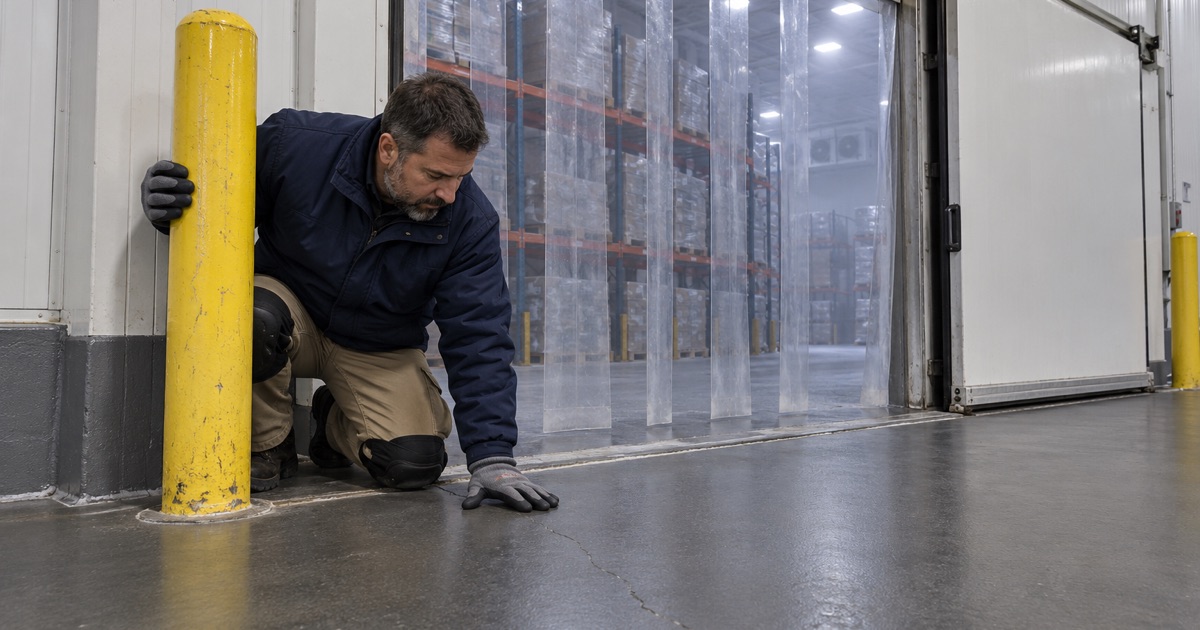
We walk the floor and map what we find before we price anything. Shrinkage cracks from the original pour, saw-cut joints that have opened, and spalls along forklift lanes are surface problems a coating crew can address. A new pattern of cracks, a joint that has stepped up on one side, a doorway that no longer closes cleanly or racking that has gone out of level all point somewhere else. Those are signs that the floor may be changing elevation, and the first call belongs to whoever maintains the underfloor heating, not to us.
Why we will not recoat over moving cracks
A crack that is still opening will reflect through any coating placed over it, usually within months. Filling it and broadcasting flake on top hides the symptom for a season and makes the next diagnosis harder. If the heating circuit has failed and the soil has frozen, recoating spends the owner’s money in the wrong place. We would rather tell a customer to call their refrigeration or electrical contractor first and bring us back once the cause is settled.
Questions we ask before pricing a cold room
Before we write a number, we ask when the underfloor heating was last checked and whether both circuits are still in service where the design has two. We ask whether doors, racking or dock plates have shifted, and whether anyone has noticed a hump or a dip in a drive lane. We also ask how long the room can be emptied and how warm it can be allowed to get, because that window decides which coating systems are even possible. The answers shape the scope more than the square footage does.
What we quote once the slab is stable
When the cracks are confirmed stable, our proposal names the crack and joint repair, the surface profile we will grind to, the product line, the number of coats and the finished thickness. Work inside an operating freezer runs colder than most standard resins are made to cure, so the system comes from a manufacturer’s low-temperature product data, never a garage epoxy pushed past its limits.
Doorways, Ice and Coating Systems for Cold Rooms
The doorway between a freezer and a warm dock or corridor is where most cold-room floors wear out first. Danfoss notes that condensed water may form on the floor in these openings and turn to ice, and that the floor there must be heated. When a doorway heater stops working, the first sign is often a sheet of ice or a patch of coating lifting at the threshold.
Choosing a system for the cold side
For rooms that stay cold and stay dry, a properly prepared 100% solids epoxy or a low-temperature polyaspartic topcoat can serve, depending on what the manufacturer’s data supports at the room’s working temperature. Where a floor sees heavy washdown near the door, urethane cement is often the stronger choice. Texture matters as well: a quartz aggregate broadcast gives boots and wheels something to grip where frost and condensation collect.
Preparation that does not change in the cold
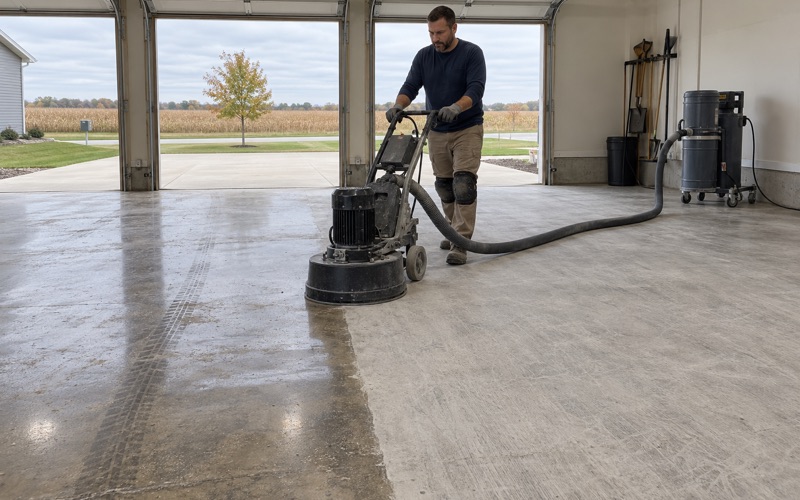
Every slab is opened with a diamond grinder or shot blaster, never acid etched, and the proposal names the ICRI concrete surface profile we are grinding to. Dust is captured at the machine by a vacuum rather than washed toward a floor drain. Because these rooms rarely get to stop, we phase the work around shifts and deliveries, with overnight and weekend windows when a room cannot go dark during the day.
Warranty limits we explain up front
Every coating warranty has exclusions, and we name them before a job is sold rather than after a failure. Moisture vapor transmission and hydrostatic pressure from below are the first two on our list. On a cold-room floor we add a third: movement of the slab itself, whether from frost heave, settlement or a failed heating circuit, sits outside what any coating can promise. A floor that stays flat and dry under a sound system is a floor we stand behind.
The rest of Waterloo’s floors
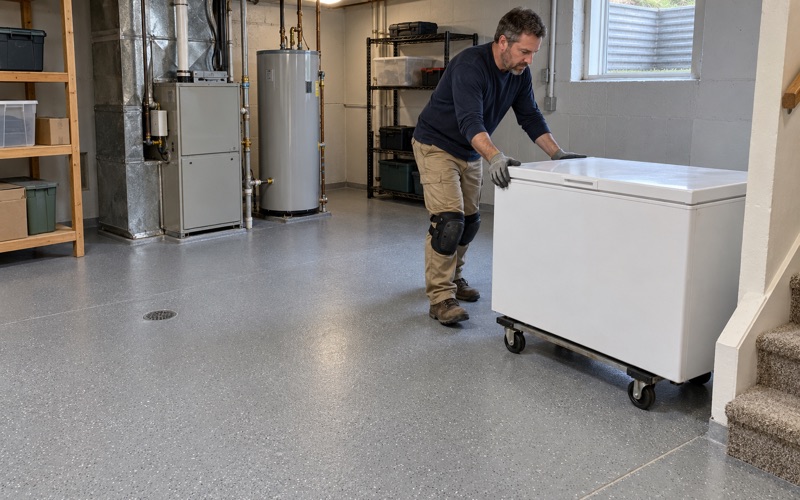
Most of the slabs we see in Waterloo are not freezers. Census figures show about three in four of the city’s homes were built before 1980, and many garage and basement floors carry decades of patches, paint and sealers. On those floors, testing what is already on the concrete, and checking moisture with ASTM F1869 or ASTM F2170 methods, decides the system long before the color chart does.
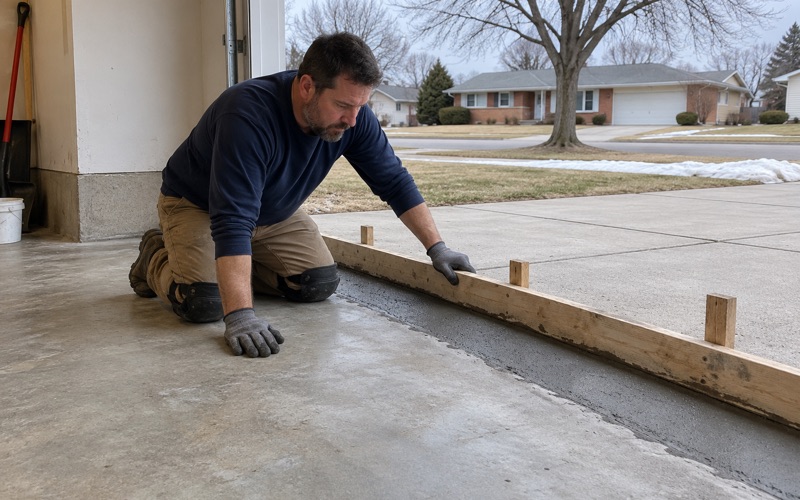
Garage floors here also carry an Iowa winter in on their tires. Brine and rock salt ride in with every car from late fall into spring, so we choose garage systems with that load in mind, and we time curing to the slab’s temperature and the dew point at its surface rather than to a date on the calendar. An unheated garage in January is told to wait. A floor coating is never sold as radon mitigation or a fix for water coming through a basement wall.
- 20+ Years of Floor Work
- Moisture Test in Every Scope
- Free Written Estimates