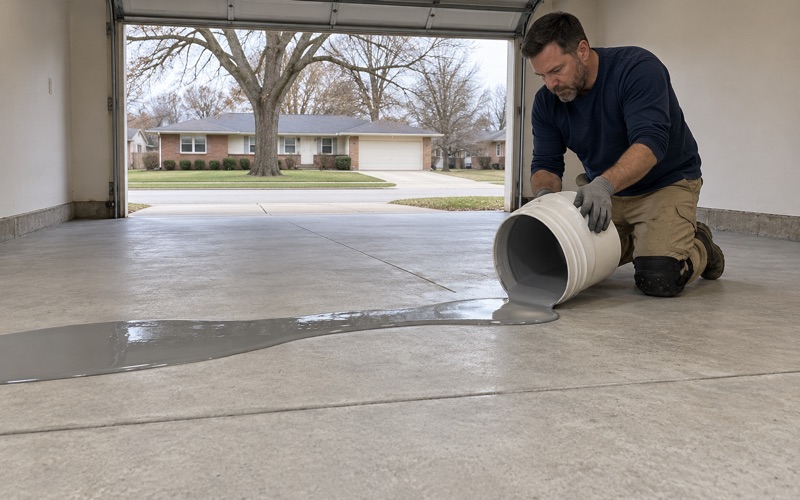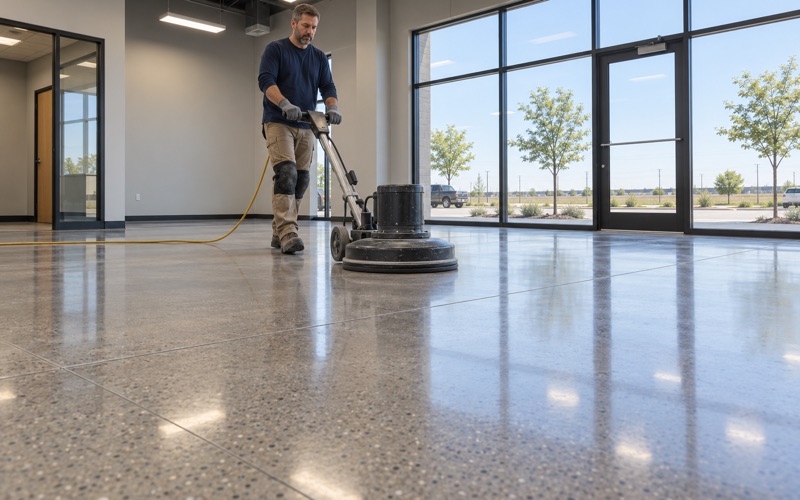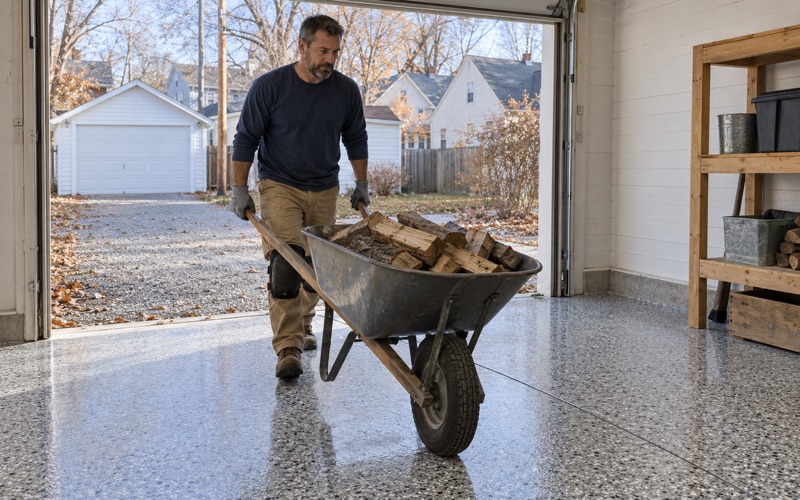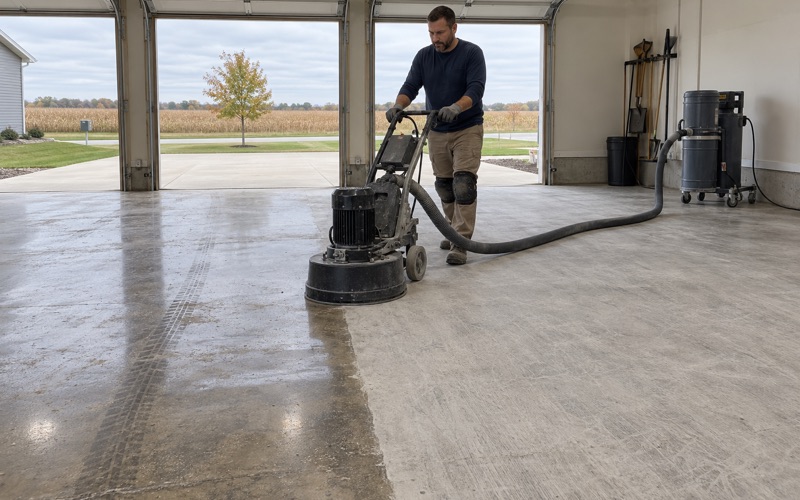
Cedar Falls Epoxy Flooring brings more than 20 years of epoxy flooring work to Independence, coating garages, basements, shops and commercial rooms with systems matched to the slab underneath them. We open every floor with a diamond grinder or a shot blaster instead of an acid etch, and the written proposal names the concrete surface profile we are cutting to, the product line, the coat count and the finished thickness.
In this town the first question about a lower-level floor is rarely which color flake to pick. It is what the building does when the river comes up, because that decides whether a sealed film belongs on the slab at all. We map cracks, spalls and old paint before we price anything, and we tell you plainly when the right answer is repair, a breathable treatment or no coating.
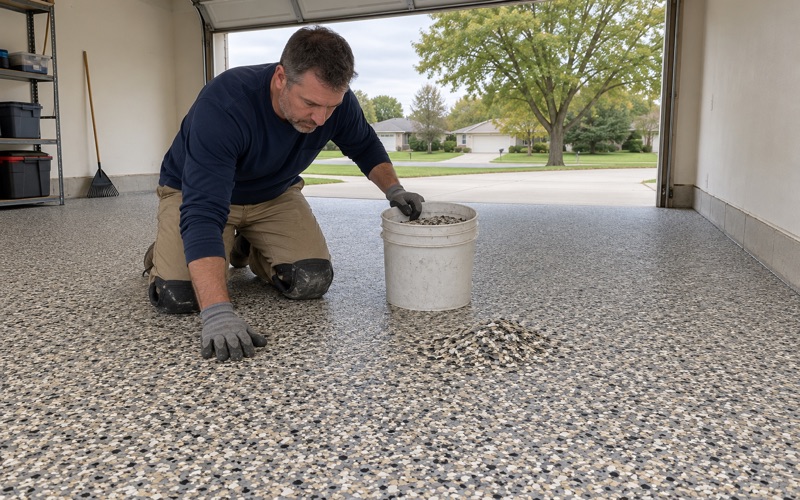
Garages and shops are the simpler half of the work here. Basements and older commercial ground floors are where a contractor has to understand flood strategy before opening a bucket, so most of this page is about them.
A River Town and Its 1867 Mill
Independence is the county seat of Buchanan County, and the Wapsipinicon River runs straight through it. Most of the city’s floors sit well away from the water, but enough of the older stock is close to it that every basement conversation should start with the river rather than with the product.
The Wapsipinicon Mill on its dam
The clearest local lesson sits downtown at 100 1st St W. The Wapsipinicon Mill went up in 1867 on a stone foundation, part of it carried over from the first mill finished in 1854, and it was added to the National Register of Historic Places in 1975. Milling stopped in 1976, and the Buchanan County Historical Society has run the building as a museum since.
A mill on a dam cannot pretend the river is somewhere else. In reporting by Iowa Public Radio, the historical society’s president described water about knee-deep in the basement when the river reached 16.86 feet in Independence, and said the building had been modified over the years to handle flooding, including a semi-permeable basement floor. That same report put the record crest at 22.35 feet in 1999.
Why a museum basement matters to a homeowner
We have never worked on the mill and have no connection to the historical society. We mention it because it shows, in public, a choice that the owner of a flood-prone building makes whether they know it or not: either the building tries to keep water out, or it is set up to let water in and get rid of it again. The floor finish has to follow that choice, not the other way around.
Looking for epoxy-flooring closer to Oelwein? See Epoxy-Flooring Services in Oelwein.
Letting the River In: Wet Floodproofing and Hydrostatic Pressure
The National Park Service publishes flood adaptation guidelines for rehabilitating historic buildings, last issued as an illustrated edition in 2021. They are preservation guidance rather than a rule, and they name no floor product, but they explain the mill’s approach better than any coating brochure.
What wet floodproofing means
The guidelines call it wet floodproofing: the building lets floodwater enter during an event and drain out as the river recedes, with water moving in, through and out at a consistent rate, largely controlled by vents. Where water will not drain on its own, a drainage system has to be designed. The approach is not recommended where flooding is expected to last longer than 24 hours, and it is best suited to spaces that nobody lives in, such as basements, crawlspaces and garages.
The point is to equalize. Water on both sides of a wall or slab pushes back on itself, so the structure is not asked to hold back a column of river on one face while the other face stays dry.
The slab under a coating
The same guidance lists the technical limits, and one of them is ours to respect. Any building component below the flood risk level, slab included, must be able to withstand hydrostatic forces. That is water pressure acting on the concrete from below and from the soil around it, and it does not care what color the top surface is.
A thin resin film adds nothing to a slab’s ability to resist that pressure. What it can do is change where the pressure ends up. When groundwater pushes up through a slab that was once free to pass moisture, a well-bonded coating becomes the new boundary, and the pressure works at the bond line. That is how blisters, lifted patches and white bloom of efflorescence show up under a floor that looked perfect the week it was finished.
Why we say this before we sell anything
Hydrostatic pressure and moisture vapor transmission are the first two exclusions we name when we explain what a coating warranty does not cover. No coating keeps a river out of a basement, and we will not describe one that way. If a slab sits below the level Independence has seen the Wapsipinicon reach, the coating is a surface for living with water, never a defense against it.
Floors That Have to Dry, and Coatings That Trap Water
The NPS guidelines are blunt about the last step: the building has to dry out after a flood. Interior spaces must be altered to allow for inundation, possible contamination, draining, cleaning and drying, and the guidance warns that drying and cleaning can take extended periods of time. It also notes that water wicks up through many materials, which is why a horizontal waterstop joint is recommended.
A semi-permeable floor is doing a job
A floor built to pass water, like the one described in the mill’s basement, is part of the drying plan. Moisture that soaked into the concrete and the soil below it has a way back out. Seal that surface with a 100% solids epoxy and the moisture still has to leave, only now it is trying to leave through a film designed to stop it.
The same logic applies to masonry. The Park Service guidance counts a sealing coating that is incompatible with historic masonry, or that is not watertight and could cause damage or deterioration, among the treatments it does not recommend. On an old stone or brick foundation, the wrong coating on the walls or the floor can hold water inside material that has breathed for well over a century.
Finishes that tolerate wetting and drying
When a basement is meant to take water and recover, we steer toward surfaces that tolerate getting wet, being scrubbed and drying out. Depending on the slab, that can mean grinding and a lithium silicate densifier with no film at all, or a thin breathable treatment rather than a thick broadcast system. Sometimes the honest recommendation is clean, sound concrete and nothing else.
Where a slab is not part of a flood path and a coating does make sense, we test before the price is final. An ASTM F2170 relative humidity probe or an ASTM F1869 calcium chloride test tells us what the concrete is releasing, and the results decide whether a moisture-mitigation primer goes down first or whether the job waits.
What to Do With a Flood-Prone Independence Basement
About a quarter of the housing units in Independence were built in 1939 or earlier, and basements of that age often carry patched slabs, layers of old paint and floor drains that have seen real water. We read those floors for history before we talk about finishes.
Read the building’s strategy first
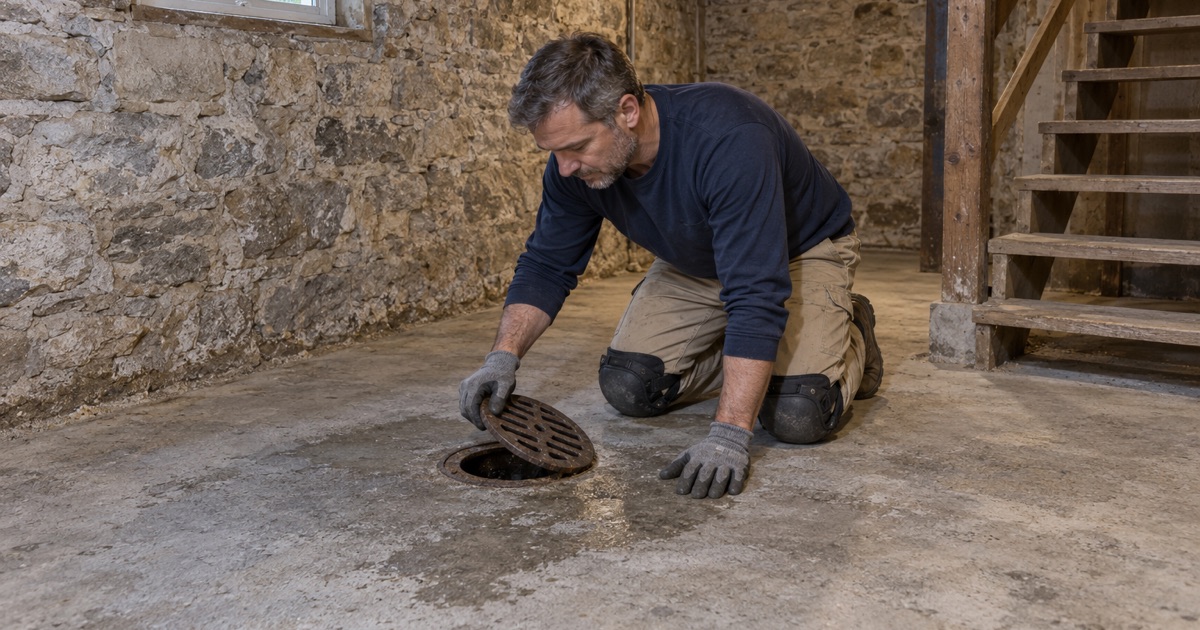
We check the sump pit, the floor drain, any efflorescence on walls and slab, tide lines on framing and old paint lifting at the low spots. Then we ask a simple question: when water came in last time, how did it leave? A basement that drains and dries on its own is already behaving like a wet-floodproofed space, and a sealed floor would fight that behavior.
If the plan is to keep the space dry through grading, drain tile, sump pumping and other work below the floor, that work belongs to the right trades, and it comes before any coating. A floor finish is not radon mitigation either; in Iowa that takes a state credential under Iowa Code chapter 136B, and we do not offer it.
When a coating does make sense
Plenty of Independence basements and ground floors sit above any water they have ever seen, and those slabs coat well. For them we grind to a measured profile, repair cracks and spalls with compatible fillers, and choose between epoxy, polyaspartic and urethane cement based on the moisture readings and how the room will be used. Low-odor products are available for basements and attached garages as a comfort choice for getting back into the house sooner.
Cure times follow slab temperature and the dew point spread at the surface, not a date on a calendar, and a cold lower level gets the time it needs. Grinding dust is captured at the machine by vacuum and never washed toward a floor drain.
What we will tell you on the walkthrough
You will hear which strategy your building is using, whether your slab is a candidate for a coating, and which products we would and would not put on it. If the answer is that a sealed floor would trap water the building needs to release, we will say so and suggest the finish that fits instead. Garages and shops in Independence get the same grinding, testing and written scope, with systems picked to handle the brine and rock salt that ride in on tires each winter.
- 20+ Years of Floor Work
- Moisture Test in Every Scope
- Free Written Estimates