
Cedar Falls Epoxy Flooring has spent more than 20 years on concrete grinding and surface preparation in Cedar Falls, IA, serving surrounding cities including Waterloo, Evansdale, Waverly, Independence and Oelwein. Grinding is the part of a floor job most customers never see once it is finished, and it is the part that decides whether a coating stays bonded for years or starts peeling within a season.
We open every slab with a diamond grinder or a shot blaster rather than an acid etch, and the proposal names the ICRI concrete surface profile we are grinding to. That gives you a specific, checkable standard for the work under your floor instead of a vague promise that the concrete was cleaned.
Grinding is also a service on its own. We remove failed coatings and old adhesive, flatten lips at joints, prepare slabs for other flooring, and take floors through the first stages of polishing for homeowners, contractors and facility managers.
Residential and Commercial Concrete Grinding
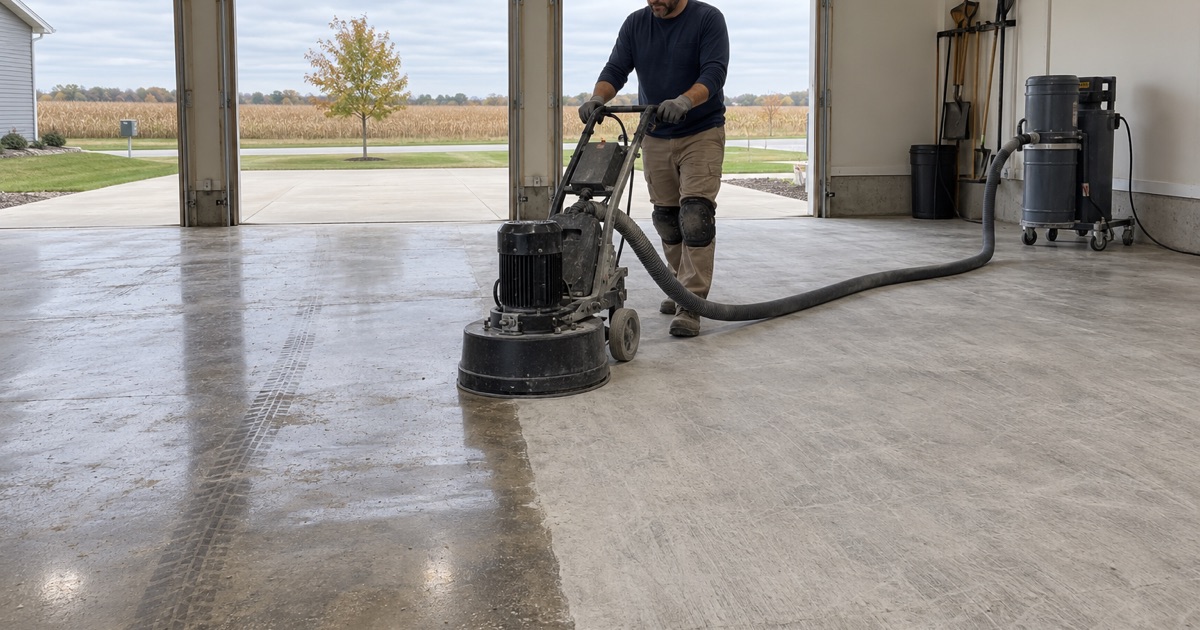
Garage and Basement Slab Preparation
In homes, most of our grinding is preparation for a garage or basement coating. We take off the weak cream layer on top of the slab, any curing compound or sealer from the original pour, and the oil, tire marks and paint that build up over the years.
Older Cedar Falls basements often carry several layers of history at once: floor paint, patching compound and the black adhesive left from tile pulled up decades ago. We grind down to sound concrete under all of it, because a new floor is only as strong as the weakest layer it is bonded to.
Shops, Plants and Warehouse Floors
Commercial slabs are larger and often contaminated with oil, coolant or hydraulic fluid. On big open floors we use shot blasting, which throws steel shot at the surface and recycles it while vacuuming the dust, to profile large areas quickly and evenly.
Edges, corners and areas around equipment are finished with smaller diamond grinders. We plan the work around shifts and production, with overnight and weekend windows when a floor cannot be shut down during the day.
Grinding Ahead of Other Flooring
Not every grinding job ends in a coating. Flooring contractors often need a slab flattened, cleaned of old adhesive or opened up before tile, luxury vinyl, wood or carpet goes down.
We grind to the flatness and cleanliness that the next trade’s product requires and leave the slab ready for them. Where moisture testing is part of their install spec, we can run the test as part of the same visit.
Surface Profile and Why We Name It
The ICRI CSP Scale
The International Concrete Repair Institute rates prepared concrete on a concrete surface profile scale from CSP 1, nearly flat, to CSP 10, very rough. Thin film coatings need a lighter profile, while thicker broadcast systems, mortars and overlays need a deeper one to lock into.
Matching the profile to the system matters in both directions. Too smooth and the coating has nothing to grip; too rough and a thin coat cannot fill the texture, leaving pinholes and thin spots.
Diamond Grinding Compared With Shot Blasting
Diamond grinding uses rotating heads fitted with diamond segments to cut the surface. It works well in garages, basements and tight rooms, removes coatings and adhesive, and can also flatten high spots.
Shot blasting produces an even profile very quickly on large open floors and is efficient at removing contamination. It is less suited to small rooms and cannot level a slab, so we choose between the two, or use both, based on the size and condition of the floor.
Why Acid Etching Falls Short
Acid etching is still common with store-bought kits and some installers because it is cheap and fast. It reacts unevenly with the slab, does little to curing compounds or sealers, and leaves salts and moisture behind that interfere with bonding.
It also cannot remove the weak top layer of concrete. A coating bonded to that layer is only as strong as it is, and when it fails, it usually lifts with a thin skin of concrete still stuck to its underside.
Our Step-by-Step Concrete Grinding Process
Step 1: Assess and Test the Slab
Before we grind, we map cracks, spalls, joints and old coatings and write a moisture test into the scope. The test results decide what happens after grinding, because a slab with high vapor readings needs a different primer or a different system.
We also check slab hardness with the grinder itself on a test pass, so we can choose the right diamond tooling for that concrete. Hard concrete glazes soft-bond diamonds and soft concrete wears hard-bond diamonds quickly, so matching the tooling keeps the profile even across the whole floor instead of shiny in one bay and torn in the next.
Step 2: Seal Off and Set Up Dust Control
In homes and occupied buildings, we seal doors, protect walls and plan around furnaces and air returns. Every grinder and shot blaster runs connected to a vacuum that captures dust at the machine.
Concrete dust contains crystalline silica, which is why collection at the source matters. We never rinse slurry or sweep dust toward a floor drain, a storm inlet or the street.
Step 3: Grind or Blast to Profile
We grind or blast the main floor to the profile named in the proposal, then work edges, corners and around fixtures with smaller tools. Old coatings and adhesive are removed completely rather than ground thin.
High spots, lips at joints and ridges are taken down at this stage where the slab allows. The surface is then checked against the target profile.
Step 4: Vacuum, Repair and Hand Off
The slab is vacuumed clean, and cracks and spalls are filled and ground flush so the coating or next flooring sees a uniform surface. On coating jobs, the primer goes down soon after so the fresh profile is not contaminated. On grinding-only jobs, we hand the slab off clean and ready, with notes on anything we found that the next trade should know about.
What We Find Under Cedar Valley Floors
Old Coatings, Paint and Tile Adhesive
Many slabs here carry old floor paint, failed epoxy kits, penetrating sealers and black mastic from earlier flooring. Each needs its own tooling, and gummy coatings can clog diamonds quickly if the wrong segments are used.
We identify what is on the floor during the assessment so the quote reflects the real removal work rather than a surprise change order. Where we cannot tell what a coating is, we grind a small test area first and price from what the tooling actually does on that floor.
Salt-Damaged and Scaled Garage Slabs
Cedar Falls is rated Severe for weathering in the city’s own design criteria, and years of road salt and freeze-thaw cycles leave many garage slabs scaled and pitted near the door. Grinding removes the loose, damaged surface and exposes sound concrete beneath.
Deeper scaling and spalls are then rebuilt with repair mortar before coating. Where damage runs through the slab, we say plainly that repair or replacement should come first.
Cracks, Joints and Settled Sections
Grinding often reveals cracks that dirt and old coatings were hiding. We map them and decide which need filling and which are working joints that must be allowed to move. A slab section that has settled or heaved significantly cannot be ground flat, and we will tell you when an overlay or replacement is the honest answer.
- 20+ Years of Floor Work
- Moisture Test in Every Scope
- Free Written Estimates